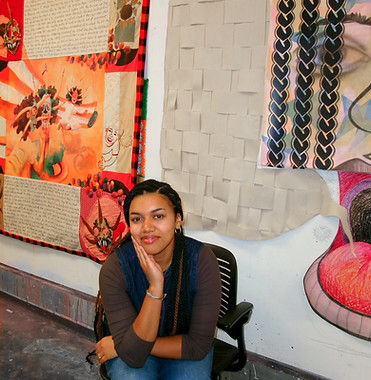
Bio
Jazzmin Imani (b. 2001, Philadelphia, PA) is a figurative artist working in a variety of mediums, including paint, charcoal, and fiber materials. She is currently pursuing her MFA in painting at Tyler School of Art & Architecture with a full fellowship. She received an AB in Visual Arts with honors from Brown University in 2023. She is a recipient of several national awards for her work, including from Scholastics, the YoungArts Foundation, and the AXA Art Prize. Most recently, Imani has been featured in shows at the Museum of Eastern Shore Culture in Salisbury, Maryland (2026), the Textile Arts Center in Brooklyn, New York (2026), and the DC Arts Center (2024). In 2019, she wrote, illustrated, and self-published the children’s book When Art is Loved, a story about the importance of regularly surrounding ourselves with art.
Artist Statement
My work embodies what it feels like to grapple with selfhood in relation to community and how to imagine the places and people we are connected to. I relate personal memories, generational stories, and broader histories to raise questions about the places I am from. By depicting these places and the people in them, I examine what we believe to be true about ourselves and what is left to be discovered or created. The work is about imposter syndrome, and diaspora, and family lineage, and longing. Each piece takes on various forms to reflect the complexities of these questions. Painting, screen printing, needle felting, and sewing all express different textures and energies across landscapes of history and memory, where central figures reenact the story being told. The uniting factor across varying senses of self, place, and material is drawing. The mark creates a specific language—a world where all of my experiences can exist at once.
My construction of Puerto Rican and African-American narratives consults a lineage of image-making. Folk art, children’s book illustration, history painting, and my favorite childhood cartoons all overlap to express my space. The figures are the narrators, while the composition collapses time into one maximal plane. Often, everything is in focus, but the gesture of the line still shows what recedes into a background of micro marks and what projects directly into the foreground as a thick line or textured fabric. In some narratives, a scene of a summer cookout or sisters dressed for a family wedding comes directly from my personal archive to unfold my lived experience. In others, a rooster fight or bomba performance is visually jumbled to reflect my limited understanding of that scene, which I know exclusively through retellings. Ultimately, different decisions are employed to reflect the variety of narratives within my experiences of time and place.
The visualization of these experiences echoes the conceptual bridge—or often, gap—between what we believe to be true about ourselves and what is left to be discovered; between one experience of American history and another; or between the viewer and the artist. Most importantly, the resulting image is a new one that is distinct from any of its parts.